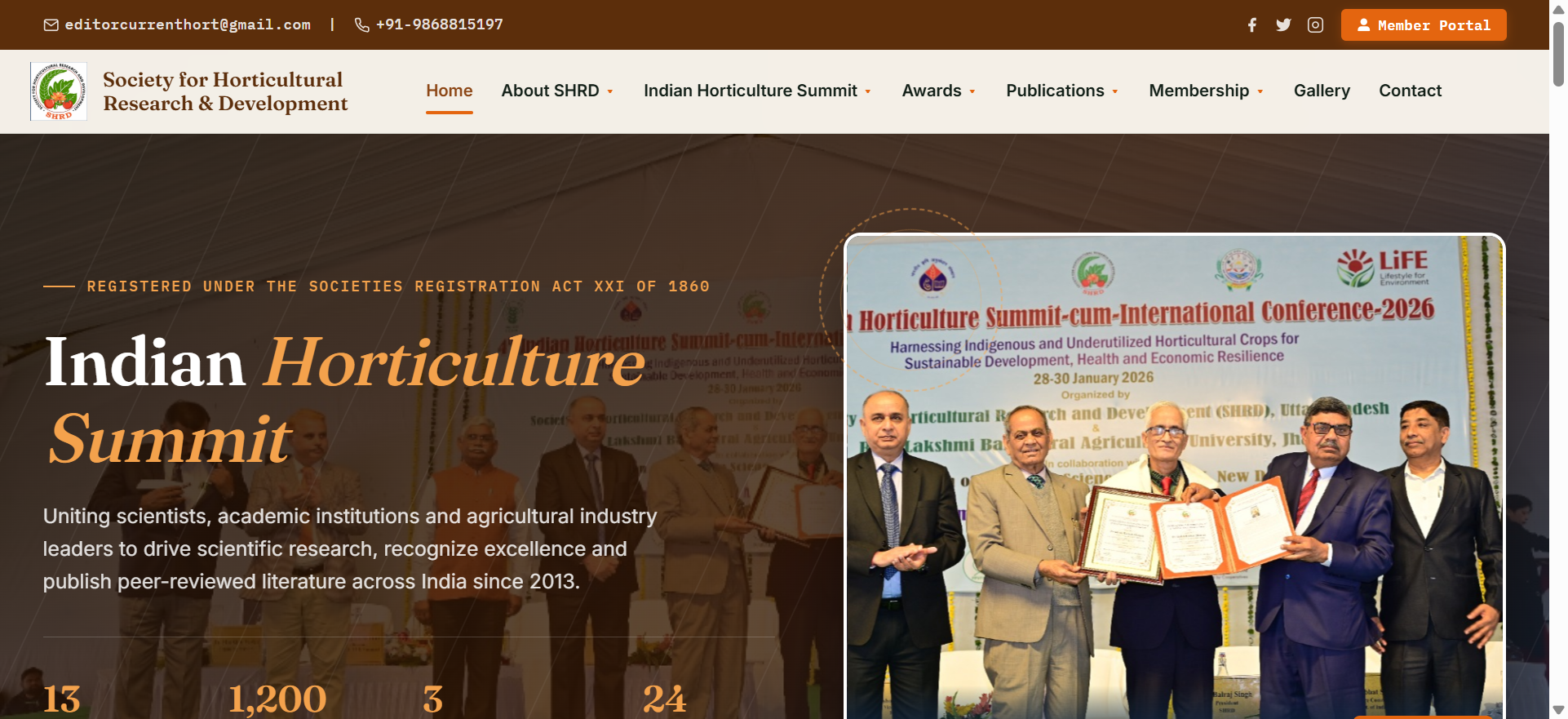
Executive Overview
The Society for Horticultural Research & Development (SHRD) is a distinguished scientific research organization established in 2013 under the Societies Registration Act. Uniting scientists, academic universities, ICAR institutions, and agricultural leaders across India and international research institutes, SHRD organizes the prestigious Indian Horticulture Summit and publishes high-impact peer-reviewed scientific journals.
The Technical Challenge
Previously, SHRD handled research manuscript submissions, author communications, reviewer feedback loops, and annual summit delegate registrations via fragmented email threads and manual spreadsheets. This caused operational bottlenecks, delayed publication cycles, and limited discoverability of published scientific volumes.
The DigiWebFX Enterprise Solution
Our engineering team architected and deployed a dedicated, high-performance web platform utilizing a robust MVC architecture with custom PHP/CodeIgniter and MySQL:
- Digital Manuscript Submission Pipeline: An intuitive author portal enabling researchers to submit research manuscripts, track peer-review statuses in real-time, and download formatted galley proofs.
- Editorial Review & Referee Management: A secure multi-tier editorial dashboard for assigning peer reviewers, collecting structured referee feedback, and issuing automated acceptance notices.
- National Summit & Conference Delegate Registration: Seamless registration flows with integrated digital payment gateways for conference delegates, life members, and award applicants.
- Searchable Journal Archive Engine: Instant full-text indexing and PDF retrieval of published research volumes, boosting citation reach and global agriscience discoverability.
- Core Web Vitals & Sub-0.8s SLA: Streamlined server-side caching and responsive, accessible layouts yielding 0.7s LCP on desktop and mobile networks.
Measurable Impact & Production Results
Following launch, paper processing turnaround decreased by 65%, while online conference registrations doubled. The digital journal archive experienced a +380% surge in international research citations and readership from 40+ countries.